お知らせ・トピック
竹田教授とWangさん(博士課程3年)が、米国で開催される麻疹ウイルスミニシンポジウムで発表しました。
竹田教授とWangさん(博士課程3年)が、米国で開催される麻疹ウイルスミニシンポジウムで発表しました。
Helen C. Levitt 2026
8th Measles Virus Mini-Symposium
Mayo Clinic, Rochester, MN
Organized by Christian Pfaller, Chanakha Navaratnarajah and Roberto Cattaneo
July 25-26, 2026, Rochester, MN
Makoto Takeda
SLAM and Nectin-4 usage by morbilliviruses across different animal species
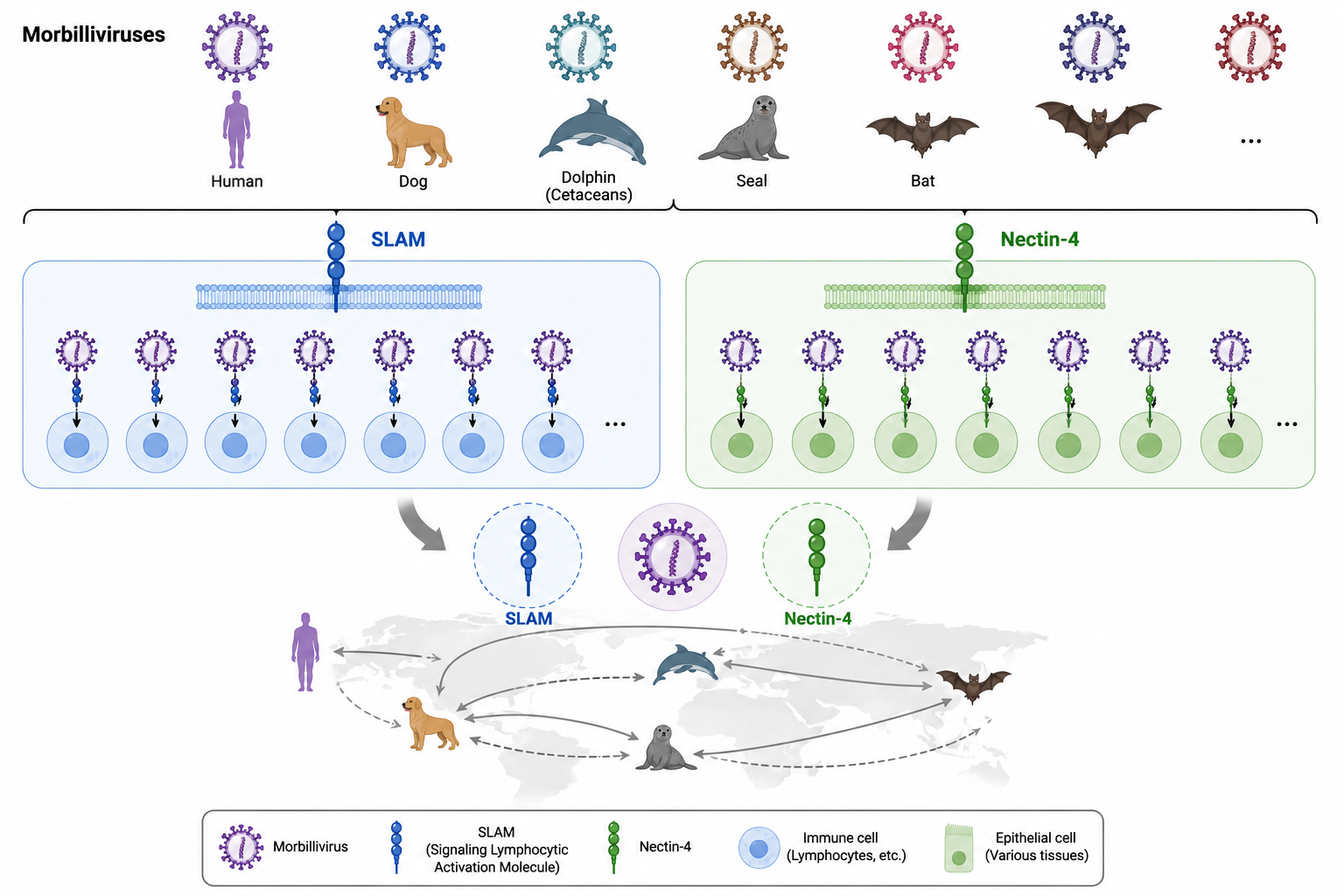
Morbilliviruses are characterized by strong transmissibility and high pathogenicity. The use of SLAM (Signaling Lymphocytic Activation Molecule) and Nectin-4 as cellular receptors is a conserved feature of morbilliviruses.
Morbilliviruses infect a wide range of mammalian species, including humans, dogs, dolphins (cetaceans), seals, and bats, although each virus generally exhibits a relatively well-defined host range. It is thought that the diversity of currently recognized morbilliviruses arose through evolutionary adaptation to different animal hosts. Consistent with this view, cross-species infection events have occasionally been reported.
However, the molecular mechanisms that determine the host range of morbilliviruses, as well as those underlying cross-species transmission, remain incompletely understood.
While Nectin-4 is highly conserved among mammalian species, SLAM shows relatively greater amino-acid sequence divergence. This observation suggests that SLAM may play a key role in determining the host range of morbilliviruses.
In this study, as a first step toward understanding the molecular basis of morbillivirus host range determination and cross-species transmission, we examined the ability of various morbilliviruses to utilize SLAM and Nectin-4 from different animal species as entry receptors. We present these findings here to share them with the morbillivirus research community and to stimulate further discussion among colleagues in the field.
Yuying Wang
Blue-light-controlled measles virus vector for oncolytic treatment of tongue cancer and melanoma


アーカイブ
- 2027年12月 (1)
- 2026年11月 (3)
- 2026年10月 (4)
- 2026年9月 (4)
- 2026年8月 (3)
- 2026年7月 (3)
- 2026年6月 (1)
- 2026年5月 (2)
- 2026年4月 (1)
- 2026年3月 (6)
- 2026年2月 (1)
- 2026年1月 (1)
- 2025年12月 (3)
- 2025年11月 (4)
- 2025年10月 (4)
- 2025年9月 (3)
- 2025年8月 (2)
- 2025年7月 (1)
- 2025年6月 (6)
- 2025年5月 (3)
- 2025年4月 (4)
- 2025年3月 (3)
- 2025年2月 (4)
- 2025年1月 (1)
- 2024年12月 (4)
- 2024年11月 (5)
- 2024年10月 (4)
- 2024年9月 (6)
- 2024年8月 (6)
- 2024年7月 (1)
- 2024年6月 (2)
- 2024年5月 (3)
- 2024年4月 (1)
- 2024年2月 (2)
- 2024年1月 (3)
- 2023年12月 (3)
- 2023年11月 (1)
- 2023年10月 (1)
- 2023年9月 (5)
- 2023年8月 (3)
- 2023年7月 (2)
- 2023年6月 (4)
- 2023年5月 (1)
- 2023年4月 (6)
- 2023年2月 (3)
- 2023年1月 (1)
- 2022年12月 (4)
- 2022年11月 (2)
- 2022年10月 (3)
- 2022年9月 (2)