お知らせ・トピック
竹田教授が、米国ウイルス学会でインフルエンザウイルスについて発表しました。
竹田教授が、米国ウイルス学会でインフルエンザウイルスについて発表しました。
July 27-31, 2026 | Minneapolis, MN
https://www.asv.org/scientific-program2026
Biological significance of subtype-specific hemagglutinin cleavage motifs in influenza A virus
Makoto Takeda, Yukiko Akahori, Yuichiro Hirata, Masatoshi Kakizaki, Yuki Kitai, Shohei Kojima, Ko Sato, Hiroshi Katoh, Kazuo Takayama, Tadaki Suzuki
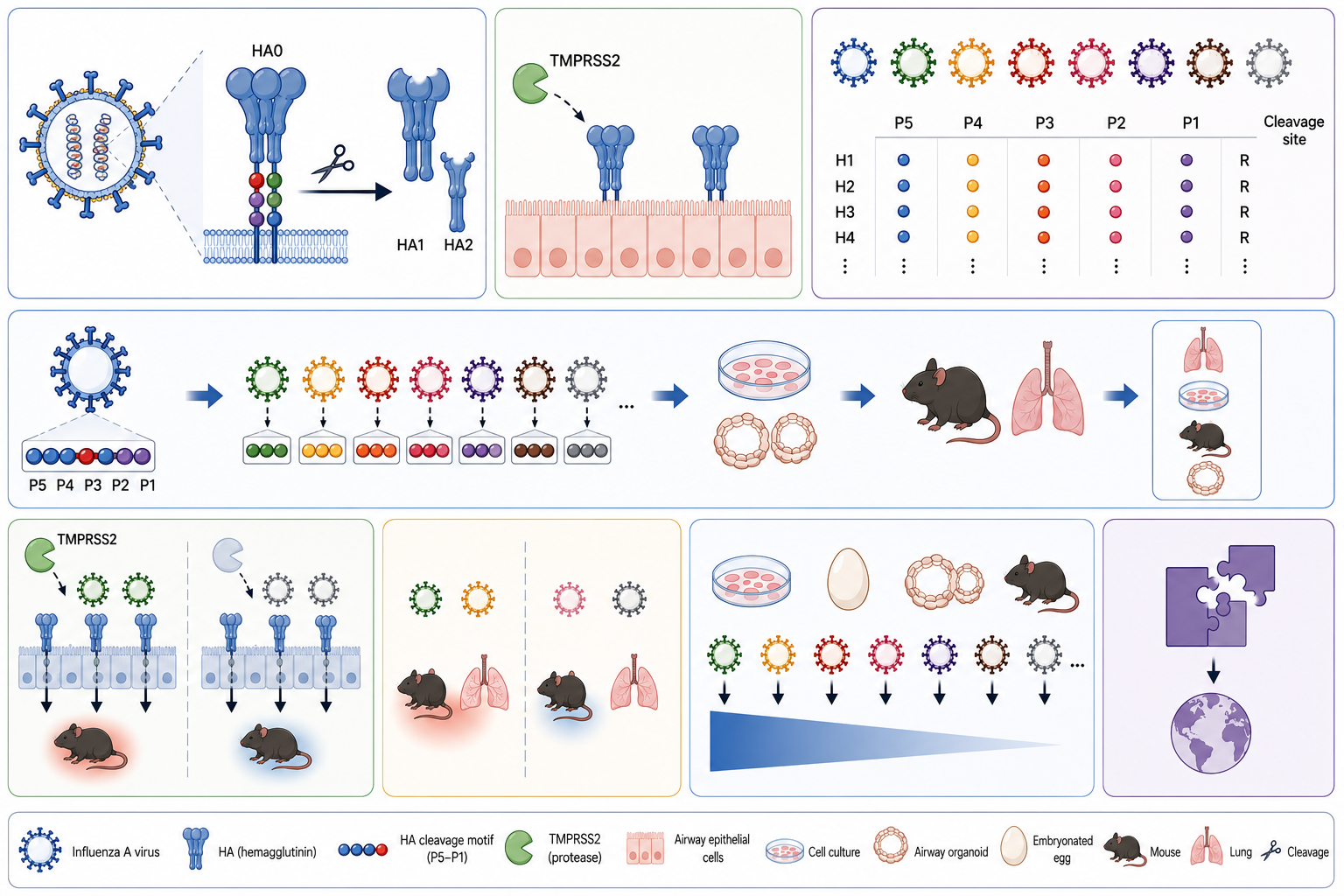
Cleavage of hemagglutinin (HA) is essential for the infectivity of influenza A virus (IAV), and the amino acid sequence of the cleavage site motif plays a major role in viral pathogenicity. It has been demonstrated that the type II transmembrane serine protease TMPRSS2 is primarily responsible for HA cleavage of H1 subtype viruses in the murine airway. IAV comprises numerous serological subtypes with substantial antigenic diversity, accompanied by marked variation in the HA amino acid sequence. Among these regions, the HA cleavage motif exhibits particularly high diversity between subtypes while remaining highly conserved within each subtype.
In this study, we analyzed the biological significance of the H1 subtype–specific cleavage motif in influenza virus replication, its contribution to TMPRSS2-dependent cleavage in the murine lung, and its involvement in viral pathogenicity. Specifically, we generated recombinant viruses in which only the H1 cleavage motif was replaced with cleavage motifs derived from 13 other subtypes, excluding H5 and H7, and examined HA cleavage, viral replication, and pathogenicity in mice.
As a result, all recombinant viruses bearing heterologous cleavage motifs replicated efficiently in cultured cells supplemented with trypsin. In contrast, viruses carrying cleavage motifs from certain subtypes exhibited moderately reduced HA cleavage in the murine lung, which was accompanied by a marked attenuation of pathogenicity. Conversely, recombinant viruses that did not show reduced HA cleavage displayed pathogenicity comparable to that of the parental H1 virus.
In addition, even in cases where no reduction in cleavage efficiency was observed, recombinant viruses with substituted cleavage motifs exhibited reduced replicative fitness compared with the parental H1 virus in competitive infection assays performed in cultured cells, embryonated chicken eggs, respiratory organoids, and mice.
These findings indicate that subtype-specific HA cleavage sequences in IAV influence protease specificity and further suggest that, beyond serving merely as protease substrate motifs, the presence of subtype-specific sequences themselves confers biological significance.


アーカイブ
- 2027年12月 (1)
- 2026年11月 (3)
- 2026年10月 (4)
- 2026年9月 (4)
- 2026年8月 (3)
- 2026年7月 (3)
- 2026年6月 (1)
- 2026年5月 (2)
- 2026年4月 (1)
- 2026年3月 (6)
- 2026年2月 (1)
- 2026年1月 (1)
- 2025年12月 (3)
- 2025年11月 (4)
- 2025年10月 (4)
- 2025年9月 (3)
- 2025年8月 (2)
- 2025年7月 (1)
- 2025年6月 (6)
- 2025年5月 (3)
- 2025年4月 (4)
- 2025年3月 (3)
- 2025年2月 (4)
- 2025年1月 (1)
- 2024年12月 (4)
- 2024年11月 (5)
- 2024年10月 (4)
- 2024年9月 (6)
- 2024年8月 (6)
- 2024年7月 (1)
- 2024年6月 (2)
- 2024年5月 (3)
- 2024年4月 (1)
- 2024年2月 (2)
- 2024年1月 (3)
- 2023年12月 (3)
- 2023年11月 (1)
- 2023年10月 (1)
- 2023年9月 (5)
- 2023年8月 (3)
- 2023年7月 (2)
- 2023年6月 (4)
- 2023年5月 (1)
- 2023年4月 (6)
- 2023年2月 (3)
- 2023年1月 (1)
- 2022年12月 (4)
- 2022年11月 (2)
- 2022年10月 (3)
- 2022年9月 (2)